The unavoidable task

Today, I’ll depart from some of the big-picture thoughts from the past week and take you behind the curtain to show you how the journalistic sausage is made. A week after getting home from Egypt, we’re almost through the most tedious part of reporting: transcribing interviews.

egypt-webjk-6879Some of these interviews ran more than 10,000 words. That’s a lot of listening, typing, rewinding, listening again to be sure we have everything right. A few months ago I posted some shortcuts to transcription. They can help, but this is still drudgery. I know other journalists who pay someone else to transcribe their interviews. That solution has crossed my mind a lot in the past week.

There’s also a value, though, in listening to an interview again – not just seeing a typed transcription. I always pick up on things that I missed the first time around. On this trip, all of our interviewees were Egyptians who spoke great English, but with an Arabic accent that was occasionally hard for a Midwestern American to understand. A second listen almost always clears up those mystery words or sentences, and helps me understand everything in the context the person said it, rather than a stack of quotes in a notebook.

Transcribing puts me back in that room with the interviewee. With longer feature stories, that’s a huge help as I prepare to write. If I’m going to put the reader at the scene, my brain needs to be there first.

So, we push through the long process and celebrate when it’s done — because now we have the puzzle pieces in a box, and we’re ready to assemble them into stories.

Posted in Reporting, Technology | Comments Off on The unavoidable task

Gendercide: A terribly common story

There’s a story out there, a very common story. It goes something like this:

I did what I wanted, how I wanted, to whom I wanted, because I wanted to do it — or at least felt I needed to. How it affects others is their business, not mine.

The End.

The documentary, “It’s a Girl,” details the consequences of this mindset, particularly in India and China.

But the consequences of the Radical Self mindset — that I can and should do whatever I want, to whomever I want — span all over the globe. And it requires some stopping and gazing intently at those consequences to confront the atrocities committed in the name of the Radical Self — atrocities like ending the life of a human being because she happens to be a girl. News out of the UK yesterday that so-called civilized people are burning fetal remains (girls and boys) to heat buildings chronicles what is simply one of the next logical steps in this Nazi-esque storyline:

  1. Woman gets pregnant.
  2. Value of the person inside her is arbitrary.
  3. Woman finds out baby is a girl.
  4. Woman doesn’t want a girl.
  5. Girl is killed in the name of choice.
  6. Like girls’ life, value of her remains is arbitrary.
  7. Girl’s body is burned for fuel.

The logic of atrocities is easy. What’s difficult is figuring out how to tell a compelling counter-story, and doing it well.

It is the job of all Christians to tell that alternative, better story with their very lives.  We cannot just go about living our lives for ourselves when the devil is writing his dark story all over the pages of humanity and destroying millions of lives in the process.  We have the better story. We are trying very hard to tell it to the world.

Are you?

Posted in Reporting, World events | Tagged , , , , | 2 Comments

Choose wisely

Had another one of those “What the heck am I doing here?” moments last Friday, attending a large prayer conference in a soccer arena near Cairo, Egypt. Of the 4,000 to 5,000 people attending, Lincoln and I were the only non-Egyptians.

beitelwadi-7171These moments happen quite often now. I’ve found myself in refugee camps just a few miles from a war zone, at the scenes of natural disasters, lost in a Middle Eastern city … even aboard a pirate ship at the edge of the Baltic Sea. The adventure quotient in my life has shot through the roof since I left a successful career teaching college journalism to follow God’s calling to the uncertainty of missions journalism.

There’s another, less attractive side, of course. My wife and I sold our house and lived for a year in a shed (today we rent a duplex). My income dropped to zero for a while, and today it’s still not even one-third of what it once was. We don’t know exactly where we’ll be living or what we’ll be doing in six months. I’d be lying if I said any of that felt fun or adventurous. We do know that all of this uncertainty leads Godward, and that motivates us to persevere.

I believe most people get a choice in life: safety and predictability, or adventure. Depending on your circumstances and personality type, great good can be accomplished in either route. But: If you’re wired for one route and have chosen the other, you will spend a lot of time feeling restless, frustrated, bored or scared.

I once read a column in The Onion titled, “Find The Thing You’re Most Passionate About, Then Do It On Nights And Weekends For The Rest Of Your Life.” It was The Onion at its cynical best, mocking all the self-help books and speakers urging people not to settle for a humdrum existence — when reality says you’re stuck with the path you’re on.

You’re not. Having experienced a nagging restlessness that eventually became a raging storm and led to a leap of faith, I can tell you that comfort and safety are vastly overrated – especially if God is calling you to an area of great need.

H. Jackson Browne Jr. wrote: “Opportunity dances with those already on the dance floor.” In other words, faith comes before clarity. If that means jumping off a diving board when you’re still not sure how much water is in the pool – which is almost always the case – then the real question becomes: How much do I trust God?

Posted in Career | Tagged , , , , , | 3 Comments

Eyewitness News

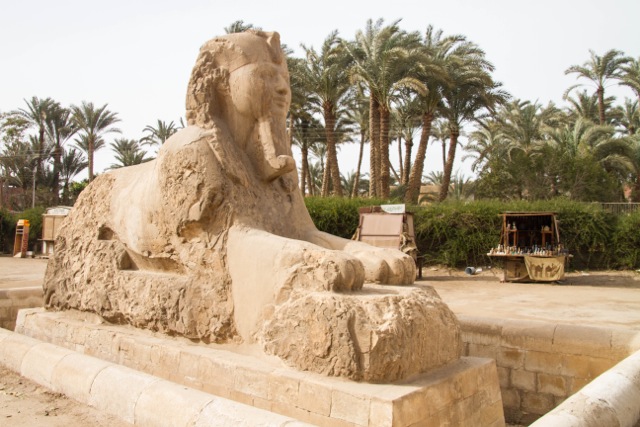
Egypt 2014 (26 of 29)Walking through the ancient remains of Memphis, Egypt, last week provided a solid reminder of just how important on-site documentation is for the preservation of history.

The sphinx shown at left is a well-preserved artifact of ancient Egypt — one of the best outside of King Tut’s tomb, in fact. There’s one small problem: Nobody knows who this depicts. Could be any one of the ancient kings of that era. We do know that the statue was carved after this pharaoh died, because his beard is curled at the end (unlike some of the straight-bearded statues of Ramses II at the same museum site). It would have taken very little time for an eyewitness to engrave the name somewhere on the statue. Alas, the historical record remains incomplete.

I’m really glad the Bible isn’t like that. I was reading Acts today, and was hit afresh with just how beautifully articulate and accurate Luke’s reportage is.

In Chapter 27, Paul and Luke and perhaps some others are in a ship headed for Rome when they get swept into a bad storm called a northeaster. In Verse 18, it says, “Since we were violently storm-tossed, they began the next day to jettison the cargo. And on the third day they three the ship’s taking overboard with their own hands. When neither sun nor stars appeared for many days, and no small tempest lay on us, all hope of our being saved was at last abandoned.”

What detail! What splendid writing! And why should we care? Because it reveals that Acts, as with almost all of the Bible’s historical documentation, is the work of first-hand reporting done by people watching the action unfold themselves.

Luke’s depiction of life at sea in the first century gibes with other sources from that era. And by making it clear that he was there, recording the dialogue and the details and the people involved, he lends enormous credibility to his story.

That’s what great reporting does. It carefully details what happens, where, when and to whom, and then lays the details out in a narrative that seizes the imagination of its readers. That’s great documentation. That’s great storytelling. Though we know our work falls short of canon scripture, we love it that our job is to report God’s work as it unfolds today, aspiring to that same level of craftsmanship. Striving for anything less would be an injustice to God and to history.

Posted in Reporting | Tagged , , | Comments Off on Eyewitness News

What God is up to in Egypt

From its infancy, our missionary journalism ministry has been about two primary things we seek to report to the church: What is God up to, and how can people get in on it?

kdec-6784The second part is easier than the first sometimes. Getting involved in missions can be as simple as writing a check or volunteering for short-term work. Telling people what the needs are, and how they can help meet those needs, isn’t all that difficult.

But first discovering what God is up to? That takes all the journalism skills we can muster, plus logistics, plus networking, plus financial support … all surrounded by a huge amount of prayer. Even once we are on site somewhere in the world, it isn’t always immediately apparent how God is working and what stories we need to tell. Discovering those takes time: finding the right people and getting to the right places.

Lincoln and I just spent 11 days in Egypt, talking with Christians at the center of a huge prayer movement that preceded the 2011 revolution and carries on today. They don’t necessarily claim credit for the revolution that toppled longtime President Hosni Mubarak. But they do believe that God protected that revolution. They believe he allowed the short, disastrous government by the Muslim Brotherhood to implode a year after it took power. They believe political Islam has been discredited and mortally wounded – not just in Egypt – and that only God could have caused that to happen so quickly.

And: They are seeing Egyptian people are coming to Christ in staggering numbers: tens of thousands every week, and that’s only the beginning. One influential pastor we interviewed believes it will spread throughout the Middle East. In fact, it already has started. He gave us a quote that sent chills through me as I wrote it in my notebook:

“We are about to see the greatest revival in the history of mankind.”

Suddenly, our central journalistic question, “What is God up to?” seems too small. More appropriately: “What is God doing that is about to shake the whole world?” Because we’ve just seen something absolutely enormous unfolding in Egypt.

Our task for the next several weeks is to report those stories carefully, accurately and completely. Please pray for us. More importantly, stand in prayer with the people of Egypt. Ask your church to do the same. As we publish these stories, share them with influential leaders.

Trust us: This is something you want in on.

Posted in Reporting, Story, World events | Tagged , , , , , , , | 2 Comments

Find the truth, know the truth

Chimpanzee_AlphatierOn your next half-hour break, take a listen to this fascinating Radiolab feature on the real origin of the AIDS pandemic. I learned all kinds of stuff — including how old HIV really is, according to some very dedicated biologists and researchers.

What really got me thinking was how expertly the researchers demolished the notion that “Patient Zero” of the AIDS epidemic was a French Canadian airline steward who launched what we have come to know as the modern AIDS pandemic, c. 1981. That’s not even close to the truth. Listen and you’ll find out why.

One thing that continually frustrates me as a journalist is that people are all too ready to accept the conclusions of lousy research (or plain ol’ fairy tales) as gospel truth. Thank the Lord for websites like Snopes.com that put the lie to rubbish that is accepted as fact. For example, contrary to a once-popular rumor, you do not have to register your cell phone number with a Do Not Call registry to keep telemarketers away. I never have, yet I never get a call from anyone trying to sell me a time share in Sarasota.

We need real truth. Christians have the real truth. He lives inside us. His name is Jesus. In his word, Jesus commands us to be very wary of lies and half-truths and ideas that sound very much like the truth, but really aren’t. In fact, we’re supposed to know the truth so well that we can instruct others in it:

“For the time will come when they will not endure sound doctrine; but wanting to have their ears tickled, they will accumulate for themselves teachers in accordance to their own desires, and will turn away their ears from the truth and will turn aside to myths.” (2 Timothy 4:3-4)

Christians need to be the best-informed people around, because our enemy, the devil, wants very much to discredit us in the eyes of a cynical and unbelieving world. The bigger suckers we are for lies, the less credible Jesus looks to the world.

We have to hold ourselves to a higher standard of knowledge and truth. Simple as that.


Posted in Faith, Reporting | Tagged , , , | Comments Off on Find the truth, know the truth

Dying to selfie

What’s the greatest photo ever taken?

oscars_selfieWell, according to the Internet this week, it was the selfie taken Sunday by Bradley Cooper at the Oscars. Host Ellen DeGeneres gathered about a dozen Hollywood A-listers and Cooper took the photo with a tablet.

That was a fun moment in an otherwise dull telecast. The photo was retweeted so many times it crashed Twitter for a half-hour. But it also illuminated something about our culture right now: In any situation, people think the best possible photo is to turn the camera on themselves, rather than toward someone or something else.

Spend a few minutes on Facebook or Instagram and you’ll find enough narcissism to make a Kardashian blush. People fish for compliments, or maybe social acceptance, in what writer John Paul Titlow has called “a high school popularity contest on digital steroids.”

How does any of this apply to missions, or to reporting on missions? Read just about any blog or Facebook post from a team on a short-term mission trip. Watch a presentation from that team after they’ve returned. Note how much of the communication is about themselves rather than the people they served.

Want to know the impression that leaves? Watch this.


There’s a far better way. Realizing the story is rarely about them, good journalists disappear. They keep the camera and microphone pointed outward. That’s more difficult than simply reporting about your own experiences, because you have to interview and photograph someone other than yourself. You have to learn others’ stories in order to tell their stories … which turn out to be a lot more interesting than yours.

Think about how much more impact that approach can have – on the people being ministered to, on the people back home … and on those reporting the story.

It’s not about us. Really, it’s not. Point the camera outward.

Posted in Culture, Photography | Tagged , , , , , | Comments Off on Dying to selfie

It’s just an angel — settle down!

If you’re looking for some levity in the Bible, an honest-to-goodness laugh, read Acts 12:12-17. Stories like this cannot be made up.

Let’s track it: The apostle Peter, fresh off a divine jailbreak, makes his way back from the Big House to his friend’s house in the middle of the night. Inside, the church brass are praying — presumably for what has, unbeknownst to them, already happened.

So Peter knocks on the gate, and a servant girl named Rhoda — sweet, excitable Rhoda — gets so amped at the sound of his voice that she leaves the poor guy kickin’ the curb while she runs inside to tell the others that he’s free. He’s standing right there, she says. Right outside!

Apologies all around, but they must have shared the family bucket of Stupid Juice that night, because it didn’t even occur to Rhoda that she had left Peter there herself, and that maybe she should go fetch him lest he be found out.

Oh, don’t worry — it gets dumber. Pick it up in verse 15: “They said to her, ‘You are out of your mind.’ But she kept insisting that it was so, and they kept saying, ‘It is his angel.'”

Can’t you just hear them? “Shut it, crazy girl! The adults are praying over here! What are you getting so excited about? What you saw was just an angel. Settle down.” OK, let’s just say it’s not Peter, and it’s not a salesman, and it really is an angel. From heaven. Right there. You don’t get up for that?

Meanwhile, Peter does the one thing he can do. He keeps knocking. Finally some of the adults go to see who it is (“My gosh, don’t these angels take a hint?!”). Then the understatement of the ages in verse 16: ” … when they opened, they saw him and were amazed.” (Maybe “amazed” was Luke’s code for “dumbstruck, like oxen trying to read Latin.”)

So after praying for Peter’s release, and after Rhoda told them point-blank that their prayers had been answered, those goobers had the audacity to be shocked. I would love to have seen Rhoda’s face about then. “Mm-hmm. Crazy girl’s gonna go over here and let you geniuses soak in the moment. Buh-bye.”

I think this is a great story because even though we Christians really can be really thick, God loves us anyway. He’s even willing to include a tale of the thickness in a book testifying to his divine, sovereign power in the early church. I like that about the Bible, that it reveals the human shortcomings that God overcomes to glorify himself and his purposes.

I hope you get a sense of that, too, as you read God’s great book of true stories.


Posted in Faith, Story | 1 Comment

Knowing your enemy

Last week, a missionary friend and I got together for coffee. In the course of a conversation about story and book ideas, we got talking about suffering and perseverance. That’s a topic familiar to most missionaries, but his next statement caught me off-guard.

“When do I suffer? When I write emails.”

This is a guy who goes to some of the lowliest slums on the face of the earth, who has given his life to bringing hope to the poorest of the poor. But suffering for him means sitting at a laptop and typing emails to solicit prayer and financial support.

I’ve known for a long time that most missionaries don’t like the story-reporting part of their jobs. It’s so critical to engaging with people who support them with prayer and money … yet it’s a constant struggle. Unless you’re wired to be a writer, or photographer, or videographer, you really don’t enjoy doing those things as part of your ministry.

My friend went so far as to say, “Satan doesn’t want me to do it.”

I’m not a Christian who believes there’s a demon hiding behind every tree, waiting to pounce on us. But I do believe we have a spiritual enemy who, when threatened, fights back. The Bible is pretty clear on that.

What if my friend is right? What if missionaries’ disdain for communicating their stories effectively is a spiritual battle? What if that opposition has been a huge, unidentified reason they don’t invest in improving those skills?

Those are questions worth processing. Imagine the Christians’ renewed engagement with the Great Commission if they could see and read what’s really happening out there. Missionaries are some of the smartest, savviest, selfless people you’ll ever meet, and they’re in some of the world’s hardest places. An intentional movement to train them to be better writers, photographers and videographers could change the face of missions.

Posted in Reporting | Tagged , , , , | Comments Off on Knowing your enemy

The PowerPoint of the Prodigal Son

Rembrandt_Return_of_the_Prodigal_Son

“Return of the Prodigal Son” by Rembrandt van Rijn

Sometimes the truth has to be dissected to be understood. But big truths don’t get communicated that way — they are best viewed and absorbed as a whole picture.

That’s why art works. That’s how art works. And I think that’s why Jesus so often used stories to illustrate, in woven verbal displays, the reality of who God the Father is.

Instead of breaking down the truth into a series of boiled-down bullet points, Jesus told stories that illustrated God’s reality in deeper (and truer) fashion than the PowerPoint-style presentations that so many people have come to prefer when it comes to studying God and the Bible.

Take, for example, the Parable of the Prodigal Son. In Luke 15:11-32, Jesus tells the story of three men: A younger son, at first deluded by selfish desire but later humbled into repentance; an older son, indignant in his self-righteousness and unwilling to forgive his younger brother’s sins; and a father, whose despite getting supremely insulted by the younger son rushes to embrace him upon his return home. It is perhaps Jesus’s most famous parable; and outside of the cross, it is his most poignant illustration of just how deep God’s love and mercy are. It is brilliant, it is nuanced, and in 22 verses vibrantly captures the beauty of the Father’s character.

But just imagine Jesus sitting down and scratching a list of bullet points in the dirt to communicate the same truths:

  1. Even though they have everything, some people turn their backs on God.
  2. Turning your back on God seems fun at first, but it can get you into real trouble.
  3. Even if you’ve turned your back on God, God will take you back.
  4. When you come back to God, expect some people who know what you’ve done to be cynical and even scoff at God’s mercy.
  5. The End

Jesus could have taught us this way. It certainly would have been more efficient when he was instructing men who sometimes had trouble grasping even basic concepts. Pastors and teachers make those kinds of lists today because it’s their job to explain scripture to people — but those lists shouldn’t take the place of the original stories. The bullet points are the take-aways. They aren’t the whole meal. 

I love gazing at paintings like the one shown here. They invite you into the scene. Great stories, great poetry and great art of all kinds do the same thing. They invite you to stop and ponder and absorb. Only by doing that can you even begin to receive the full experience of God’s beauty.

And isn’t that better than a list?

Posted in Uncategorized | Comments Off on The PowerPoint of the Prodigal Son