It helps that the topic is one my favorite movies. But what the Des Moines Register has accomplished with its “Field of Dreams at 25” package of stories, videos, photos and graphics is pretty special. Take a few minutes to check it out.
This package takes a very large story – especially significant for the paper’s Iowa audience – and breaks it into chapters and installments based on the best way to tell each part of the story. Then, it’s all pulled together in an interactive online package that can best be read on a tablet.
This is the future of in-depth journalism. Unfortunately, most newspapers have nowhere near the resources to pull this off. Niche publications, though, are another matter. For instance, as Crossfield News evolves quickly in the coming months and years, we envision taking packages to this level – packages like our current Egypt coverage.
Imagine telling God’s stories with an unmatched format and quality level. Imagine the impact that could have.
I attended the visitation service this past weekend for a man I never met.
His name is Steve. He’s the husband of our youngest daughter’s 3rd grade teacher, a woman who actually has taught all three of our daughters at the same elementary school. Steve was only 60 years old, a healthy-as-a-horse athlete whose racing bibs hung on long strings around the church lobby like party streamers. He was planning to retire next month from a 31-year career teaching chemistry at UW-Stevens Point so that he and his wife (who also was set to retire) could travel and spend more time with their kids and grandkids.
And now he’s gone. He died while training for a triathlon.
Looking at all the photos and sympathy notes and racing bibs decorating the walls, it was hard to be unimpressed by this man. The mementos testified that Steve lived a very full and worthwhile life. The stunned looks on many people’s faces also testified that his death came as a shock, as if there was no way he should have passed away when he did.
But really, why not? That a man as active and accomplished and warmly loved as Steve was could be taken so unexpectedly was a cold reminder that we’re all headed there. Few of us will die in a similar way, but we’re going to die. Death has a very good batting average against humanity.
What are you doing with your time here? What are you doing to take full advantage of God’s gift of life to you? It’s a very big world with a lot of hurts — hurts that God has given you gifts to help rectify. He has given us all gifts that He intends for us to use for His glory and the benefit of others.
Maybe you don’t expect to die today. I certainly don’t. But if you do, what will the story of your life say?
Posted inFaith|Comments Off on We’re short-timers in a big world
The video shown below is terribly, terribly shot. If ever there was a lesson on the value of a tripod, this is it.
Get past that, though, and listen to the better lesson: the importance of being a first follower. Go ahead, watch it now.
When I left a comfortable career to pursue missionary journalism, I was following a good friend who would have no problem being described as a lone nut doing something great. My journey so far hasn’t looked the same as his. It may never. But we are convinced that God has put us onto something great. Pursuing it is worth the risk of looking stupid in front of a bunch of people.
Now we are looking for more nuts: people who want to help stir this movement to tell God’s stories better … people who have been earnestly praying about what God wants them to do with their careers, and now are ready to do something about it.
Last week, after I wrote about the need for journalists to join us, I heard from several of you. You believe God is leading you in this direction. One, in fact, is taking a huge step of faith financially and joining us at the Evangelical Press Association convention in a couple of weeks – because she feels God asking her, “Do you trust me?”
God always rewards steps of faith. Always. And it’s almost never the reward we would have expected. That’s what makes following hard after him such an adventure. If you’re restless, prayerful, skilled and ready to take a chance, contact us. We need you. We’re tired of doing this goofy dance by ourselves.
Welcome to another edition of: “Look what those nutty Christians are up to now.”
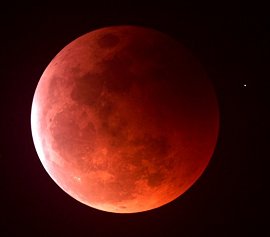
NASA photo
Lots of media reported on Tuesday’s blood moon – a lunar eclipse where the sunset glow from the Earth is reflected onto the moon, making it appear red. It was the first of four such events – together called a tetrad – over the next two years.
A USA Today story focuses on an interesting religion angle to this, drawn from Acts 2:19-20:
And I will cause wonders in the heavens above and signs on the earth below —blood and fire and clouds of smoke.The sun will become dark, and the moon will turn blood red before that great and glorious day of the Lord arrives.
The USA Today headline — Does Tuesday’s ‘blood’ eclipse signal the end times? – violates a standard rule for headline writers: Don’t ask a question that the story doesn’t answer.
“Texas televangelist pastor John Hagee sees the four blood moons as evidence of a future ‘world-shaking event’ that begins to fulfill End Times prophecy,” the story says.
It doesn’t quote Hagee directly. The quotes used are secondhand, from a sermon reported by a UK publication called Christian Today. Hagee’s sermons on the topic can be found on YouTube. He’s a bit, uh, out there.
Tucked about halfway down the story is this line:
A spokesman for the televangelist said tells (sic) USA TODAY on Monday that Hagee “has not associated the blood moons with the end of days.”
Wait. What? Didn’t you just tell us that he does believe that? Isn’t the whole story set up on that premise? Hagee’s sermons sure seem to indicate that he believes it.
No further explanation is given. The story moves on to some general evangelical beliefs about the end times, and a NASA scientist talking about eclipses. It’s interesting stuff, including past dates of these tetrads that have been significant in Israel’s history. But we’re left to wonder whether this end-of-days stuff is widely believed.
This USA Today writer followed the standard template for stories involving both science and religion: Find a nutty pastor or televangelist, preferably from the Deep South, who’s been saying something provocative. Quote him, and don’t worry if it’s secondhand or out of context. Then interview a scientist to balance the nutty guy. Don’t bother talking to any credible evangelical theologians or authors – or Christian astronomers — who might offer a level-headed view of all this. There isn’t time or space for that.
What we end up with are stories that, rather than making anyone think, just push people’s buttons. Science or religion? Readers only get to choose one.
Good journalism searches for the truth. Lazy journalism plucks the low-hanging fruit and simply reinforces stereotypes. Too bad, because with better sourcing this could have been a fascinating story.
A few days ago here in Wisconsin, it was in the 60s. The air was warm. Children laughed and played. Adults laughed and played. The grip of winter lay broken under the weight of sunshine and joy and …
Spring 2014, central Wisconsin – photo by LB
“What’s that you said, Mr. Weatherman? Winter storm warning? Liar! March just crawled away like a whimpering lamb …”
Poor, deluded soul. Spring is the ficklest season, tempting you with charms only a fool would embrace. She dances with many partners — winter, summer, tornado. She loves you, drenches you, then freezes you — giggling all the while at your torment.
But we don’t lose hope. There are a lot of things in this world to lose hope over this spring (for me, it’s my always-awful Chicago Cubs). But the weather sure isn’t one of them, no matter how hard the wind blows.
During what came to be known as the Arab Spring three years ago, new winds of hope blew through Egypt like a sandstorm. Everyday people with almost nothing in their pockets and little hope of change finally got so sick of living in constant fear and stuck-ness that they gathered by the hundreds of thousands in Tahrir (Liberty) Square, in central Cairo, to force the authorities to change or be changed.
Spring 2011, Cairo – photo by Jonathan Rashad
They got changed. First Hosni Mubarak. Then the Muslim Brotherhood, the mother of all terrorist organizations, which the people and the army ousted after the Brotherhood spent its year in control terrorizing its own people with violence and the arrogance of power. If the demonstrations illustrated just one thing, it was the eagerness of people who wanted change, who needed change, to band together despite what appeared to be deep religious and social differences.
This was particularly on display with Muslim and Christian protesters, who protected each other from gangs of thugs and stood side by side to pray and even worship in Tahrir Square during some tough days, when demonstrating could get you beaten, jailed or even killed. And when the largest evangelical church in the Middle East, Kasr el-Dobara, opened up its building near Tahrir Square as a field hospital to treat the people who were injured in the demonstrations, it gave Christians a brand-new profile in the country. It moved the church from “outsider” status to “fellow Egyptian” status.
With that new profile, Christians in Egypt have fresh reason for hope. But they also need our prayers. As we tell their stories on Crossfield News, please pray for them as they pursue God’s call to spread the hope of Jesus Christ to everyone, everywhere across their nation.
Last night, I had the opportunity to speak at church about what’s been happening in Egypt: a prayer movement that has accompanied the revolution and now is leading to unprecedented numbers of people coming to Christ, from all backgrounds.
As I spoke with people afterward, their most common response was: “ I had no idea that all of this was going on.”
This is an extremely missions-minded church that supports missionaries and ministries in strategic spots all over the world. And yet, a tremendous movement of God in one of the most spiritually important places on earth has gone largely unnoticed. We find this to be true of God’s work in many other places, too. He is doing something big, but the worldwide church is largely unaware.
That’s usually not the church’s fault. Romans 10:14 says, “How can they hear about him unless someone tells them?” That certainly goes for people unreached by the gospel, but it also goes for people who need to know what God is doing in the world. The eternal cost of telling God’s stories poorly – or not telling them at all – is staggering. If people don’t know, they don’t pray. They don’t give. They don’t send. And they don’t go.
If you are a missionary, you need to be a reporter, too. You are the link between what God is doing in your field and the worldwide church that needs to know. If you lack the skills to effectively tell God’s stories from where you are, we can help. Pick up our book, “Go Tell It,” which releases May 1. We also offer in-person training to mission agencies and ministries worldwide in reporting, writing, photography and videography. Ask us about it.
If you are a journalist, we need you! Your skill set is critically important to the Great Commission. Talk to us about how to get involved. Maybe it’s a short-term trip with us now and then. Maybe it’s doing interviews from home, by Skype. Or maybe it’s a whole new career calling that could put you in places you never dreamed of working … all with an eternal significance.
Today, I revisited a blog post I wrote in January 2011, just after the bombing of the Saints Church in Alexandria, Egypt. I can view it today with a different lens, after visiting Egypt and hearing Christians there talk about what that awful night did. No one knew it then, but it was the beginning of an unprecedented movement of unity and prayer among Egyptian Christians. We’re currently working on stories about that powerful unity and its impact on a revolution that began three weeks later.
So, as a preview to those Crossfield News stories coming soon, here’s that 2011 post again:
What if your faith cost you something? I mean, what if it really cost you something … like your sense of safety, or even your life?
On New Year’s Eve, as a worship service ended, a suicide bomber struck a Coptic Christian church in Alexandria, Egypt, killing 21 people and injuring about 100. The video above shows some of the aftermath.
Christmas on the Coptic calendar falls on Jan. 7, just a week after the bombing. Across Egypt, churches were packed – even the one that was bombed. According to a Catholic Online story:
Refusing to cower to Islamic terrorists, members of the Coptic Orthodox Church attended Christmas services in droves. An official for Egypt’s Catholic community said, “We fear no one, and nothing will prevent us from going to our churches in this country of the martyrs.”
Elsewhere in the Middle East, Christians are being quietly driven out of Iraq. Others are being arrested in Iran. This NPR story describes the roundup of 70 Christians today in Iran, then makes this observation:
“In the West, the followers are drawn to house churches because of the intimate sense of religious fellowship and as an alternative to established denominations. In places such as Iran, however, there also is the effort to avoid monitoring of sanctioned churches from Islamic authorities — who have kept closer watch on religious minorities since the chaos after hard-line President Mahmoud Ahmadinejad’s disputed election in 2009.
Groups monitoring Christian affairs in the Islamic world say Iranian authorities see the unregulated Christian gatherings as both a potential breeding ground for political opposition and suspect they may try to convert Muslim in violation of Iran’s strict apostasy laws — which are common throughout the Muslim world and have at times fed extremist violence against Christians and others. …
“It’s the nature of the house churches that worries Iran. It’s all about possible converts,” said Fleur Brading, a researcher for Middle East and North Africa at Christian Solidarity Worldwide, a British-based group the follows Christian rights issues around the world. “It’s a very specific and pinpoint strike by Iran.”
We ignore news stories like these at the risk of alienating ourselves from the heart of God.
It’s so easy here in comfortable, isolated America to approach church as a consumer: This one has good music, but that one has better teaching and kids programs, and I like the coffee better. Persecution to us means people make fun of us or think we’re weird, and that makes us uncomfortable.
Can you imagine any of those Iranian house churches splitting because of disagreements about whether to sing traditional hymns or Chris Tomlin songs? Can you imagine explaining to Egyptian Coptics how their American brethren sometimes don’t attend church because it meets at an inconvenient time?
Better, imagine the faith required to worship in a sanctuary still splattered with the blood of fellow believers. Imagine life with the real possibility of being blown to eternity because you choose to identify with Christ.
At the very least, this could prompt us to spend a little less time praying for our own safety and comfort and more time praying for the persecuted Body of Christ around the world.
Posted inCulture, Reporting|Comments Off on Costly faith … three years later
Malaysia Airlines Flight 370 went missing one month ago, carrying 239 people who almost certainly are now dead.
But what happened to that plane? That’s the question still burning in the minds of family members and people around the world one month on. Of course the families and friends of the missing care — they want to know what happened to their loved ones. Where are they? Why did they die? Did they die? Was it a hijacker? A suicidal pilot? A cabin fire? Losing someone you love is horrible enough, but losing them and not knowing what happened … that must be an agony all its own.
I don’t know how that feels. I can’t imagine waking up each day and staring into the cold void of not knowing what happened to my missing father or mother or child.
Somehow knowing what happened helps us cope with terrible things, even when the weight of that terrible thing is too much to bear. Maps, instructions, cultural tips from an experienced voice — knowing truth helps our minds navigate reality, just like flipping on a light keeps us from tripping over the coffee table.
But without truth, without those details, the mind can’t connect the loose ends flapping in the wind. I think that’s the essence of closure — the ability to stitch pieces together into something solid and manageable.
People need truth to make peace with their lives. I guess it shouldn’t surprise us how quickly this leads to the Bible, where Jesus — the Truth himself — told us that finding Him results in peace and rest. Could it be that truth, any truth, carries the aroma of its Originator? Certainly we wouldn’t choose the horrors that truth so often uncovers, but knowing the Truth himself helps us cope with those horrors because their power can’t match His.
I hope that the pings those search teams heard earlier this week really did come from MH370’s black boxes. I hope the surviving friends and family learn the real story of what happened to their loved ones, if only so they can confront the truth, somehow embrace it and cope with the solid facts of what happened instead of wandering in the void of not knowing.
Posted inStory, World events|Comments Off on MH370: The cold void of not knowing
In the late 1960s, Bill Cosby did a classic stand-up routine about Noah and the ark – imagining what those conversations between Noah and God must have been like. Or between Noah and his neighbors (“Hey! Yo up there! What is this?” “It’s an ark.” “You wanna get it out of my driveway? I gotta get to work.”)
I listened to Cosby endlessly as a kid and thought this bit was hilarious. I don’t remember ever thinking, “Oh, so that’s how it really happened.”
Likewise, nobody attends a Christmas pageant and believes the angels were all 7-year-old girls with glitter halos, or that any of the shepherds wore glasses. Nor do audience members storm out of the church because the pageant doesn’t exactly match what’s in the gospels.
So why are so many people so concerned when a major Hollywood film sticks pretty much to the Genesis account of Noah but takes imaginative liberties where the Bible is silent or vague? Don’t worry, we get it: This is not a documentary.
Darren Aronofsky’s “Noah” was the most thought-provoking movie I’ve seen in a long time. Not because it is completely true to Genesis; it never purports to be. But from beginning to end it made me think, “Could that have happened this way?” An imaginative director’s take on early, wicked humanity and God’s rescue plan was fascinating, frightening, at times spectacular and – I believe – honoring to God.
Also fascinating was the presentation of Russell Crowe’s Noah as a conflicted, imperfect man struggling to honor God and sometimes making terrible decisions. Given the little we know about Noah, and the flaws we do know about other Old Testament heroes, I didn’t think this was so far-fetched.
The other thing “Noah” did was drive me back into Genesis chapters 6-9 to check details and to see how closely the film followed them. (Tons of other moviegoers have been doing the same thing, according to the people who run YouVersion, Bible Gateway and other Bible sites or apps.) The answer is a mixed bag, but the film is surprisingly true to the Bible on some of the minor details. Even when the film interprets Genesis’ Nephilim as giant, hammer-swinging rock-men, all you can really say is … well, there’s another stab at a question no one’s ever been able to answer with much certainty.
The film’s most noticeable and direct contradiction of Genesis is in deciding which humans wind up on the ark. Aronofsky leaves a couple of crucial people off until very late, adds another and … well, it’s complicated. It all plays into a dramatic storyline that probably wasn’t needed.
Nor were the extended fight scenes needed. I get bored by most blockbuster adventure films because they so quickly become one long battle sequence with endless explosions. “Noah” doesn’t do that, but a couple of times it does seem to forget it’s not part 4 of “Lord of the Rings.”
But that’s being picky. “Noah” is a really good movie that I want to see again. It’s uncommon, and refreshing, when a piece of biblically based entertainment makes me think, instead of just telling me what to think.
“Liars.” That was the description we heard in Egypt of journalists from CNN and Al-Jazeera, among other news agencies covering the country.
CNN is disliked in Egypt for reporting lines like this: “Morsi, Egypt’s first democratically elected president, had been toppled in a military coup in July 2013.”
Cairo’s Tahrir (“Liberation”) Square, ground zero for the 2011 and 2013 revolutions.
Well, sort of. That oversimplifies and distorts a people’s revolution that the army simply supported and carried out to prevent huge bloodshed. People who sympathized with the second revolution – and that’s an overwhelming majority of Egyptians – see CNN’s wording as a sign of sympathy with the Muslim Brotherhood. They believe that all news coming out of Egypt is vetted by the MB and spun in that direction. Western journalists are viewed as either complicit plotters or unsuspecting dupes.
I’m not in a position to say whether that’s correct or not. Typically in America, people quickly assign bias when what we’re really seeing is lazy, underinformed reporting. I can say, though, that recent actions of Egypt’s interim government do not represent a step toward a free and open society. The arrest of three Al-Jazeera journalists on terrorism charges – they are accused of “spreading lies” and working in alliance with the Muslim Brotherhood – is frightening. Basically, they have been imprisoned because the government thinks they are biased. That smacks of the Soviet-style imprisonment of dissidents. No free country – and that’s what Egypt aspires to be – imprisons journalists for their points of view. (Nor does it order the executions of 529 people after a sham trial, no matter which terrorist organization they may sympathize with.)
Much as American Democrats disdain Fox News or Republicans vilify just about everyone else, the only thing risked by political journalists in the U.S. is loss of credibility and audience. It makes me crazy when I hear otherwise-bright people on either end of the political spectrum talk about how they wish their demonized news source could be shut down. I hope Egyptians don’t take cues from short-sighted reactionaries on America’s left or right.
Thomas Jefferson said: “Were it left to me to decide whether we should have a government without newspapers, or newspapers without a government, I should not hesitate a moment to prefer the latter.”
And if you think the U.S. news media are biased today, read some newspapers from the 18th and 19th centuries.
With Egypt, I get it. This is uncharted territory and they are figuring things out as they go. The crackdowns, I think, represent a heated overreaction to Egyptians’ newfound disdain for the MB. Things need to calm down, and there’s reason to believe they will. By most accounts, next month’s presidential election should help bring stability.
Egyptians we talked with agreed that the country’s new constitution needs a few tweaks – particularly in limiting the powers granted to the army. On the good side, it renders freedom of belief as absolute (not just “protected”) and gives encouraging nods to free expression and free press.




 Go Tell It
You must be logged in to post a comment.